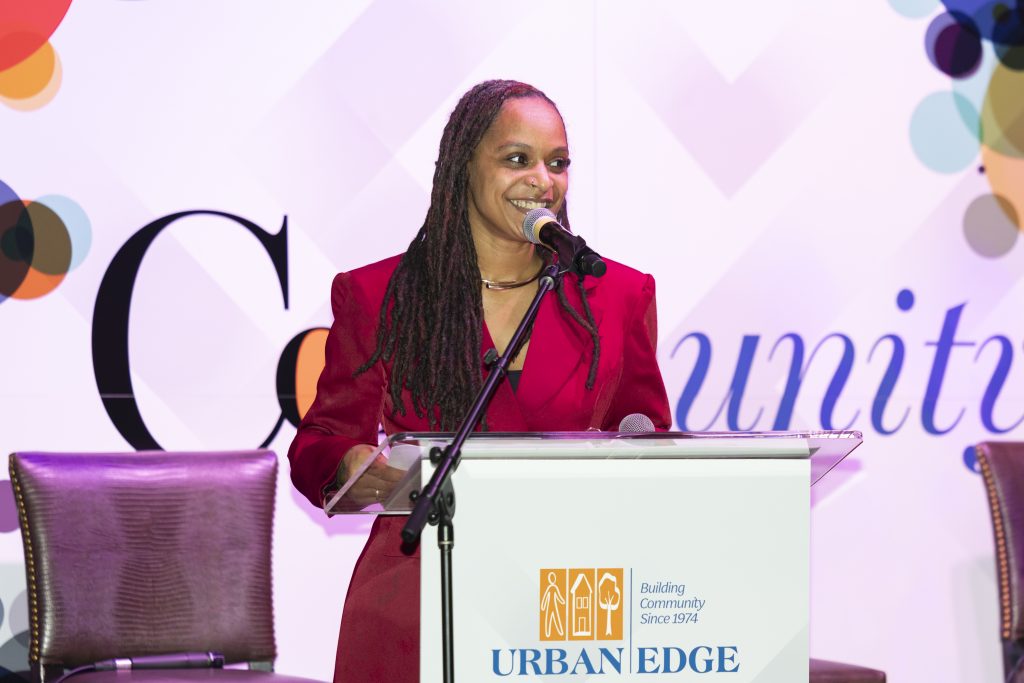
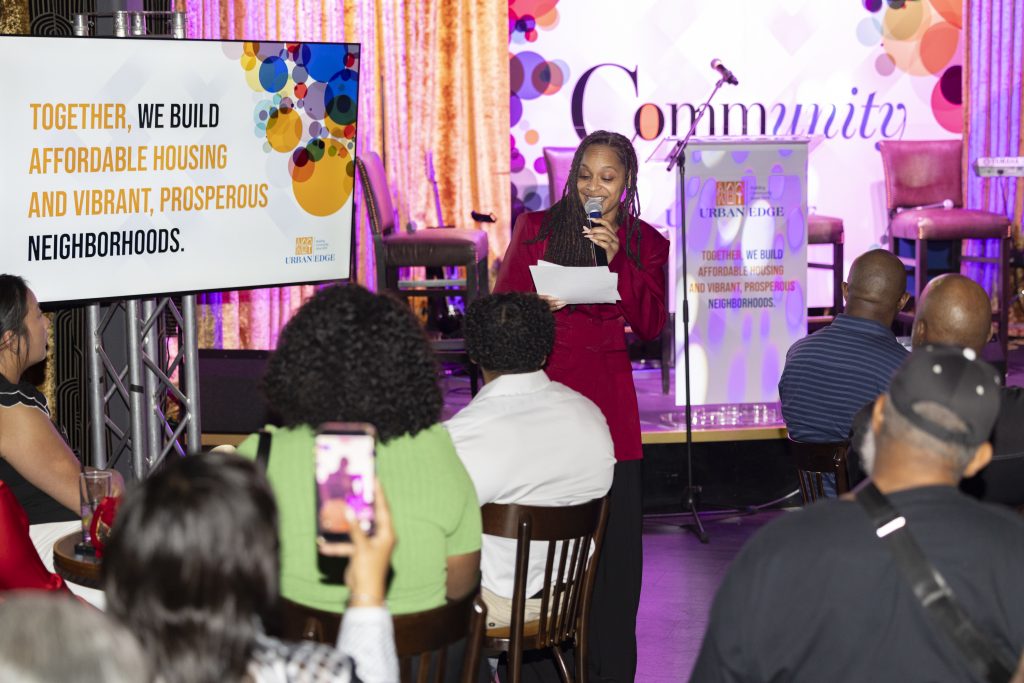
Urban Edge was honored to welcome Amanda Shea to our Community 2026 event. Through her powerful spoken word piece, “Urban Edge,” Shea reflected on the realities faced by many within our communities. Her energy, authenticity, and rhythm brought the room together, creating a true sense of unity as we celebrated the work accomplished and looked ahead to the journey still to come.
In the red-brick pulse of Urban Edge, the city learns how not to abandon its own children.
Not with speeches. Not with ribbon cuttings or polished miracles smiling for cameras.
But with hands.
Steady hands.
Hands smelling of sawdust, bus transfers, coffee, paperwork, hands that understand how poverty can settle into the lungs like winter air through cracked windows.
They work where train tracks hum beneath Jamaica Plain like tired arteries beneath an exhausted body, where Roxbury winters climb apartment floors like something alive, where mothers fold overdue bills into kitchen drawers like burial clothes.
The city was choking quietly.
Not all at once— not with sirens or headlines— but slowly, the way a candle drowns inside its own wax.
Windows went dark. Children learned the language of eviction before multiplication. Dreams were priced out block by block, heartbeat by heartbeat.
And still—
people stayed.
Because leaving a neighborhood is sometimes like peeling your own name from your skin.
There were grandmothers here whose laughter still floated in hallway walls. Fathers whose fingerprints slept inside light switches. Front stoops worn smooth by generations of tired bodies coming home at dusk.
Then came the men in pressed shirts with silver pens and empty eyes, measuring human lives by market value.
Luxury towers rose like polished teeth over neighborhoods already bleeding.
Entire families became ghosts before they even packed.
But somewhere beneath the concrete, something refused extinction.
Like roots beneath frozen soil. Like a match hidden in wet wood. Like a pulse.
Urban Edge arrived not as savior— no white horse, no gleaming rescue descending from the clouds—
but like hands returning ribs to a wounded body.
They lifted collapsing porches the way a grandmother lifts a sleeping child from the backseat after midnight.
They stitched affordable homes into neighborhoods ripped open by greed and eviction notices, threading dignity through cracked concrete with the patience of people who still believe a city can love you back.
A home, they said, should not feel like borrowed breath.
And suddenly—
families planted tomatoes inside coffee cans again.
Children raced bicycles down sidewalks that no longer felt temporary.
Elders sat on stoops like rooted trees refusing the storm.
In classrooms smelling faintly of dry erase markers and burnt coffee, first-time homebuyers held trembling pens as though signing their names onto the future itself.
Credit scores became resurrection stories.
Debt loosened its fist.
Foreclosure letters— those sharp white envelopes of despair— met counselors who spoke softly enough to remind people they were more than what they owed.
At the VITA center, tax forms unfolded like complicated prayers.
Volunteers bent over paperwork as if translating hope into numbers the government might finally understand.
Meanwhile, teenagers once walking streets like abandoned prayers began speaking with thunder in their throats.
Someone told them their voices mattered.
And when a child believes that— really believes it— the earth shifts a little.
Their voices became drums.
Sacred drums.
The kind that call a neighborhood back to itself.
Corner stores bloomed cautiously through asphalt cracks. Barbershops buzzed like summer cicadas. Cafés glowed against February darkness. The smell of cumin, garlic, rice, and onions rose from apartment windows like hymns refusing extinction.
People planted flowers outside buildings they once feared loving.
Because love is dangerous when everything can be taken from you.
But they planted them anyway.
That is the miracle no one talks about:
how poor people continue loving places that have not always loved them back.
How they sweep sidewalks they do not own. How they memorize neighbors’ birthdays. How they carry groceries upstairs for elders without being asked. How grief gets shared at bus stops. How laughter escapes apartment windows in July like birds refusing cages.
Because a neighborhood is never just buildings.
It is the woman singing gospel while sweeping her front steps.
It is the uncle fixing bicycles in the alley.
It is children double-dutching beneath flickering streetlights.
It is tired workers nodding to each other at dawn like survivors recognizing survivors.
It is belonging.
And belonging, in America, has too often been auctioned away to the highest bidder.
But here— in Jackson Square, in Egleston, in streets surviving redlining, sirens, displacement, and forgetting—
people held onto each other like survivors crossing floodwater.
And somewhere in the middle of all this, hope stopped being a word.
It became brick.
It became kitchens glowing after midnight.
It became fathers crying quietly in bathrooms after unlocking doors that finally belonged to them.
It became children sleeping deeply without hearing whispered arguments about rent.
It became roots.
Deep roots.
The kind that split stone open from underneath.
The kind cities cannot evict.
The kind that crack concrete simply by insisting on living.
And in the red-brick pulse of Urban Edge, the city remembers itself again—
not as profit, not as property, not as skyline—
but as people.
As hands.
As drums.
As kitchens lit warm against winter.
As names refusing erasure.
As roots stretching stubbornly beneath the pavement, waiting for spring, waiting for sunlight, waiting for the moment the whole city finally blooms.
Amanda Shea is an Emmy-nominated, three-time Boston Music Award-winning Spoken Word Artist, as well as an educator, activist, filmmaker, producer, host, and curator. She founded Free Verse, an open mic series and cultural platform committed to amplifying radical imagination through art, truth-telling, and collective liberation. Her work can be found in the Museum of Fine Arts, The Boston Globe, TEDX, TEDxRoxbury, Netflix, Prime Video, BBC News, GBH, and more. Shea will be releasing her first book, “Pieces of Shea,” in 2026. Her work examines her personal life experiences, social justice issues, and healing through trauma, utilizing art as a tool.